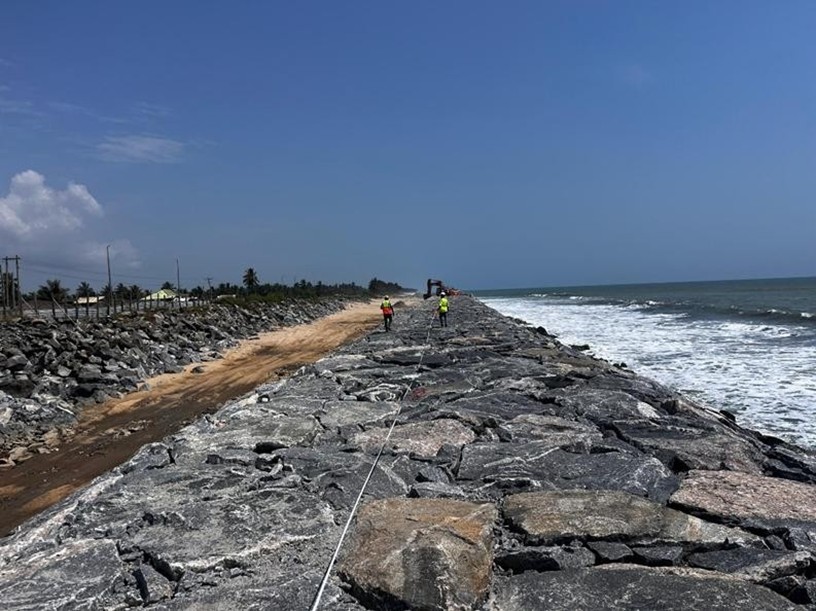
Phase II of the Cape Coast Coastal Protection Project forms a critical extension of the overall shoreline stabilization programme along the Cape Coast coastline. The phase focuses on the construction of extensive armour rock revetments, lateritic backfilling, and armour rock groynes across the Duakro, Brofuyedru, Ekon, and Moree sections to ensure continuous and long-term coastal protection. This report presents a comprehensive overview of activities undertaken during the reporting period, including work progress as at the end of 2024 and December 2025, site inspections, stakeholder engagements, submission of technical documents, financial and contractual milestones, and an assessment of the current construction and near-completion status of the works.
OVERVIEW OF SCOPE OF WORK
The scope of works under Phase II includes:
• Construction of armour rock revetment
• Lateritic backfilling behind revetment structures;
• Construction of armour rock groynes;
3. WORK PROGRESS STATUS
3.1 Progress Status as at End of 2024
Construction works under Phase II formally gained momentum in December 2024. Key activities and milestones achieved by the end of the year included:
• Submission of a payment request by M/S Vuluxx Company Limited on 1st December 2024 for works executed;
• Release of Interim Payment Certificate (IPC) No. 1 by HYDRO on 3rd December 2024;
• Forwarding of IPC No. 1 to the Ministry of Works and Housing on 5th December 2024;
• Application by the Ministry for the release of funds to the Contractor on 12th December 2024;
• Initial construction works commenced, including laying of the revetment base at Abakam (CH 450 m), with a design elevation of 3.0 m over a planned span of 1,500 m.
By the end of 2024, Phase II works were at an early but clearly established stage, with site mobilization, base construction, and administrative processes actively underway.
3.2 Progress Status as at December 2025
By December 2025, Phase II had recorded steady and encouraging progress across multiple sections, notwithstanding site-specific challenges.
Duakro Section
• Significant advancement achieved, with revetment base construction extending beyond 700 m toward the planned section length;
• Additional base construction carried out between CH 780 and CH 850;
• Toe line setting-out completed, with construction of both sea-side and land-side slopes over extended chainages;
• Capping works commenced in the last quarter of 2025, covering approximately 191 m, marking a transition from foundation works to finishing activities;
• Trimming and slope refinement works ongoing to improve structural alignment and resilience.
Brofuyedru Section
• Revetment base construction completed up to approximately CH 410 m;
• Works align with approved engineering profiles and provide a stable foundation for subsequent slope and capping works.
Moree Section
• Preparatory and enabling works progressed satisfactorily;
• Revetment base construction ongoing over approximately 141 m;
• Site accessibility and logistics have improved significantly;
• Continuous stakeholder engagement is being undertaken to foster community cooperation and support sustained construction activities.
Ekon Section
• Progress remains relatively slow due to community concerns and non-acceptance of certain design aspects;
• Engagement efforts are ongoing to address concerns and facilitate smoother implementation.
Overall, over 1 km of revetment base has been constructed to date, placing Phase II on a positive implementation trajectory.
4. SITE VISITS, INSPECTIONS AND STAKEHOLDER ENGAGEMENT
4.1 Site Inspections and Monitoring
Regular site inspections and measurement exercises were undertaken to assess construction quality, certify works executed, and guide payment processes. Key inspection and measurement activities included:
• Progress Memo dated 16th January 2025, confirming revetment base construction at CH 450 m; • Progress Memo dated 5th February 2025, confirming extension of revetment base to CH 500 m;
• Construction Inspection Meeting held on 23rd May 2025, based on inspection conducted on 25th March 2025, at which time revetment base length stood at 600 m, with an average height of 2.5 m and width of 20 m;
• Measurement of Works Memo dated 11th August 2025, following inspection on 23rd July 2025, confirming measured revetment base length of 722 m against a planned length of 800 m;
• Measurement of Works Memo dated 8th December 2025, based on inspection conducted on 26th November 2025.
4.2 Stakeholder Engagement
Stakeholder engagement has been a continuous activity throughout Phase II implementation and has included:
• Coordination meetings between HYDRO, the Contractor, and the Ministry;
• Engagements with community leaders and residents, particularly at Ekon and Moree, to address concerns relating to design alignment and landward impacts;
• Ongoing consultations aimed at minimizing disruptions and fostering community ownership of the project.
5. SUBMISSION OF TECHNICAL DOCUMENTS
A range of technical and contractual documents were prepared, reviewed, and submitted during the reporting period, including:
• Interim Payment Certificates Nos. 1 to 4;
• Revised design drawings submitted on 24th February 2025;
• Method Statements and Implementation Plans (MSIPs) and the Contractor’s Environmental and Social Management Plan (C-ESMP) submitted on 25th February 2025 for approval and implementation;
• Progress and measurement memos;
• Official correspondence relating to delayed payments and requests for fund releases;
• Requests for supervision service funds, including the submission dated 29th December 2025.
6. MEASUREMENT AND NEAR COMPLETION STATUS
Measurements undertaken throughout 2025 confirm steady advancement of works, particularly in the Duakro and Brofuyedru sections. While Phase II is not yet at completion stage, the project has successfully transitioned from initial base construction into slope construction and capping activities in selected sections. The progressive shift toward finishing works indicates a healthy construction trajectory.
Tidal variability and strong wave action, especially at Duakro, continue to pose operational challenges. Nevertheless, design considerations are being reviewed and adapted where necessary to enhance structural resilience, particularly in areas adjacent to critical infrastructure.
7. SITE INSPECTION AND STRUCTURAL ASSESSMENT
Site inspections confirm that completed revetment bases are structurally sound and conform to approved design specifications. The constructed bases provide adequate bearing capacity for subsequent slope and capping works. No major structural defects have been identified to date. However, construction progress at Ekon and parts of Moree remains constrained by community-related challenges. Continued stakeholder engagement and resolution of design concerns are essential to achieving uniform progress across all sections.
8. OVERALL SUMMARY OF WORK DONE
• Phase II implementation commenced and gained momentum from December 2024;
• IPCs Nos. 1 to 4 raised and submitted within the reporting period;
• Over 1 km of revetment base constructed across project sections;
• Duakro and Brofuyedru sections showing strong construction progress;
• Capping works commenced and completed over 191 m in selected areas;
• Revised drawings, MSIPs, and C-ESMP submitted and approved for implementation;
• Regular inspections, measurements, and stakeholder engagements conducted;
• Community-related challenges affecting progress at Ekon and parts of Moree are being actively managed.
Phase II of the Cape Coast Coastal Protection Project is progressing steadily and remains on a positive trajectory. Despite challenges posed by tidal conditions and community-related concerns in certain sections, substantial progress has been achieved, particularly in the Duakro and Brofuyedru areas. Continued focus on stakeholder engagement, adaptive design responses, and completion of slope and capping works will support timely delivery and ensure long-term coastal resilience along the Cape Coast shoreline.
Photolog: