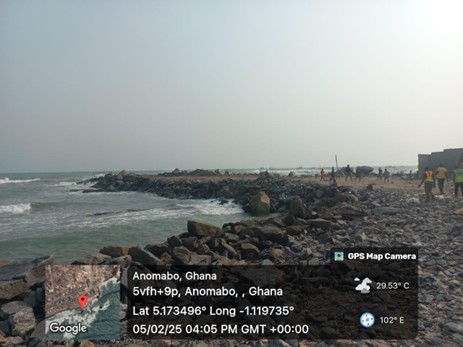
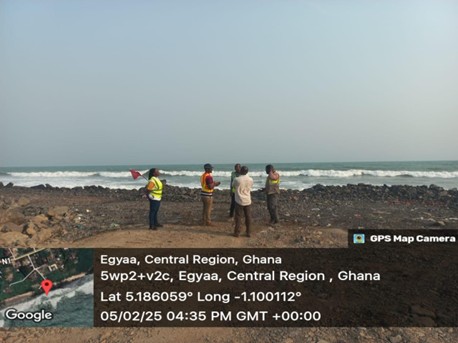
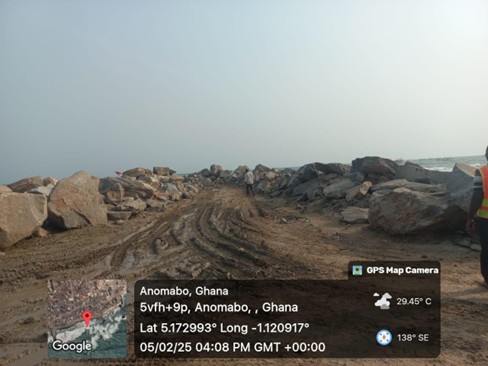
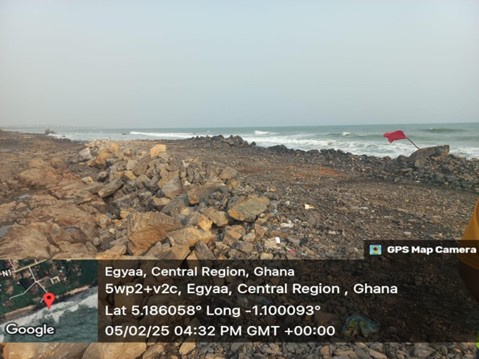
This report presents the technical progress, site observations, stakeholder engagements, and major challenges recorded under the ongoing coastal protection activities within the Anomabu–Egyaa–Biriwa–Abandze coastal stretch during the 2025 reporting period. The works fall under the Government of Ghana’s programme to safeguard vulnerable coastal communities from persistent shoreline erosion, infrastructure loss, and socioeconomic disruption.
PROJECT OVERVIEW
Coastal protection interventions within the zone include construction of armour rock revetments, groynes, breakwaters, and associated site preparation works. The primary objectives are to stabilize eroding shorelines, protect critical infrastructure, and preserve livelihoods such as fishing and small-scale commerce.
3.0 PROGRESS OF WORKS
3.1 Anomabu Coastal Protection Project (Egyaa Extension)
3.1.1 Field Activities – February 6
• Armour rock revetment base laid to an elevation of 2.5 m at Chainage 0.074.
• Access created to the beachfront to facilitate truck movement and armour rock stockpiling.
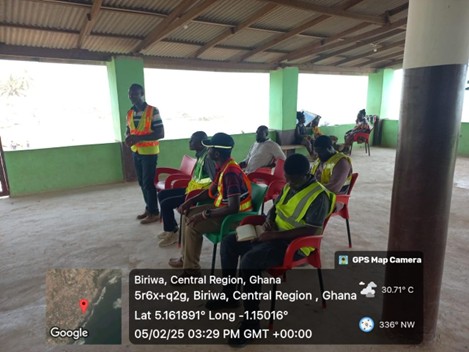
3.1.2 Monitoring Visit – February 5–6 (Biriwa Community)
• Engagement with traditional leadership recorded significant concerns regarding accelerated coastal erosion.
• The chiefs requested the construction of two additional breakwaters as part of long-term shoreline stabilisation.
• The Authority assured stakeholders that ongoing coastal modelling and shoreline studies would guide the suitability of proposed structures.
• Additional revetment works completed up to 2.5 m elevation over a 74 m stretch.
3.2 Existing Coastal Structures (Legacy Works)
A summary of prior completed or ongoing structures within the project zone is as follows:
• Armour rock revetment: 2,380 m long, constructed to an elevation of 5.0 m.
• Groynes: Five (5) completed; construction of slopes for three (3) groynes ongoing.
• Breakwater structure: Base constructed to a length of 147 m at an elevation of 2.50 m.
3.3 Management Site Visit – May 2–3
Observations indicated steady progress in mobilization and early-stage works at Egyaa, including:
• Provision and maintenance of access roads to the site.
• Establishment of site office, camp facilities, washrooms, and repair/support structures.
• Submission of design documentation to the supervising team.
• Construction of armour rock revetment base covering 550 m length.
3.4 Contractor Communication – April 7
The contractor reported a request from the Estiwaa Fishermen Association, seeking an expansion of the existing wharf to enhance safety and reduce risks to lives and fishing assets. This request has been noted for technical review and potential integration into future scope adjustments.
3.5 Community Engagement – July 8–9 During another field mission:
• Community stakeholders proposed converting Groyne 3 into a breakwater, citing improved wave attenuation benefits.
• The proposal has been forwarded for coastal modelling review to evaluate structural, hydraulic, and longshore sediment transport implications.
3.6 Additional Works at Anomabu
• The site experienced minimal progress during the latter months of the reporting year, attributed to delayed funding releases.
• The revetment base at Egyaa No. 3 currently stands at 0.6 m in height, pending further construction.
4.0 ABANDZE COASTAL ZONE STATUS
Construction activities remain suspended due to community resistance.
• Residents continue to demand that the originally proposed groyne be replaced with a breakwater, which they believe offers stronger protection against severe erosion.
• Stakeholder consultations will continue to ensure alignment between engineering designs and community expectations while maintaining structural sustainability.
5.0 STAKEHOLDER & COMMUNITY ENGAGEMENT SUMMARY
Engagements were conducted with community leaders, fishermen associations, and local government representatives across Anomabu, Biriwa, Egyaa, and Abandze. Key outcomes include:
• Heightened public awareness of ongoing interventions.
• Requests for additional breakwaters, wharf expansion, and modification of existing design components.
• Improved coordination between the Authority, contractor, and beneficiary communities.
6.0 CHALLENGES 6.1 Technical Challenges
• Delays in armour rock supply at certain chainages.
• Limited access routes requiring frequent maintenance to support heavy vehicular traffic.
6.2 Financial Challenges
• Delayed payments significantly slowed progress, particularly at Anomabu–Egyaa No. 3.
6.3 Social Challenges
• Community resistance at Abandze is affecting work continuity.
• Requests for non-designed structures requiring additional modelling and scope review.
The 2025 reporting period demonstrated moderate progress across the Anomabu–Egyaa coastal protection corridor, with notable achievements in revetment base construction, community engagement, and ongoing legacy structure performance. Challenges related to funding delays and community resistance remain critical factors influencing project timelines. Strategic stakeholder communication, sustained financing, and technical assessments of requested interventions (such as breakwaters and wharf expansion) will be key to ensuring project continuity into the following year.
Photolog: